

Your Attractive Heading
Über die Formula Student
Was ist die Formula Student?
Formula Student is a global engineering design competition, where students from universities around the world develop and build single-seated racing cars.
However, winning is not all about building the fastest car. Victory belongs to the team which excels in all aspects: design, performance, cost planning, and business strategy. Teams are judged by experts from motorsport, automotive, and supplier industries, who assess both the technical quality of the car and the team’s business approach.
In Europe, the regulations for Formula Student competitions are set by the organizers of Formula Student Germany (FSG)erstellt, wodurch FSG zum Dreh- und Angelpunkt vieler weiterer Events geworden ist.
Why Students Build Formula-Style Cars?
Es ist nicht Geld das uns motiviert - denn alles was wir tun ist ehrenamtlich. Viel eher ist es die herausvorderung die die Formula Student stellt, über den theoretischen Tellerrand des universitären Lehrplans hinauszuschauen und unser Wissen in einem Echt-Welt-Projekt einzusetzen. Es vereint Teamwork, Zeit- und Projektmanagement, Ingeniuersfähigkeiten und wirtschaftliche Raffinesse.
By taking part, students gain valuable experiences that are beneficial to them as future engineers. They also gain more exposure to the automotive industry, since companies often use Formula Student as a platform to meet and recruit new talents.
How Does Businesses and Partners Benefit?
Die Formula Student bietet Unternehmen aus Motorsport, Automobil- und Zulieferindustrie eine einzigartige Möglichkeit, die Fähigkeiten junger Ingenieure zu bewerten. Durch die Förderung von Teams können sie frühzeitig Kontakte zu hochmotivierten Studierenden knüpfen. Die Beteiligung als Juror, Mentor oder Förderer bietet zudem wertvolle Einblicke in die nächste Generation von Ingenieurtalenten.
Disziplinen
There are a lot of Formula Student competition events globally each year. While they all have their own specialties that make them unique, they all share the same core disciplines a.k.a. events in which teams must compete. Those are separated into two major categories: dynamische und statische..
Dynamische Events
Dynamic events test the performance of the cars on track. Each event would evaluate the vehicle’s different physical features such as acceleration, skid pad, autocross, endurance, driverless trackdrive and efficiency.
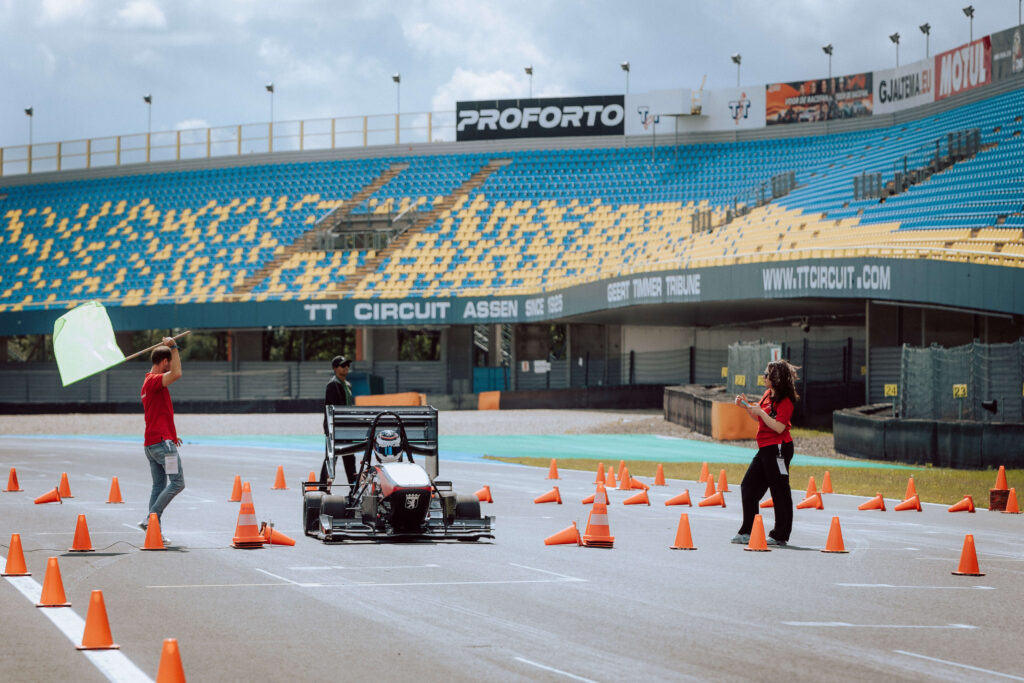
The car’s ability to accelerate is tested on a straight 75-metre stretch. Besides traction, the powertrain design plays a major role, whether in aiming for maximum output or strong torque delivery. The fastest cars complete the run in under four seconds and surpass 100 km/h before the finish line.
Maximum scores: 50 (with driver) and 75 (driverless).
In this event, each car will have to navigate a figure-eight circuit marked by cones, completing two laps each circle, in which the 2nd lap would be recorded. The result could be comparable to the highest possible lateral acceleration. Many designs rely on aerodynamics to increase contact pressure, hence, raise lateral speed. Hitting cones would lead to time penalty.
Maximum scores: 50 (with driver) and 75 (driverless).
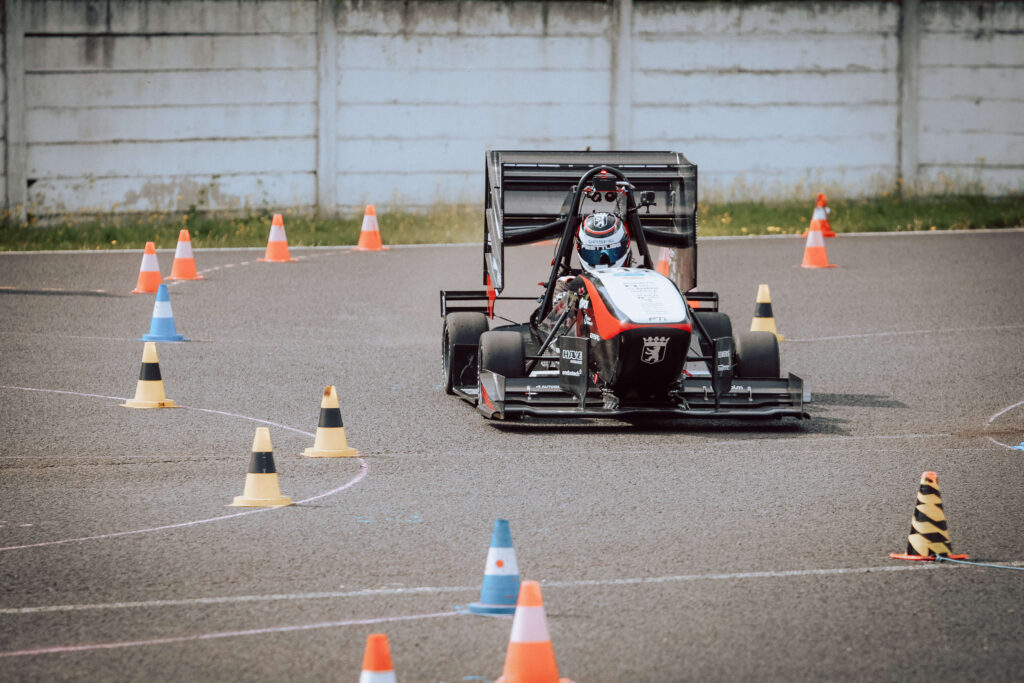
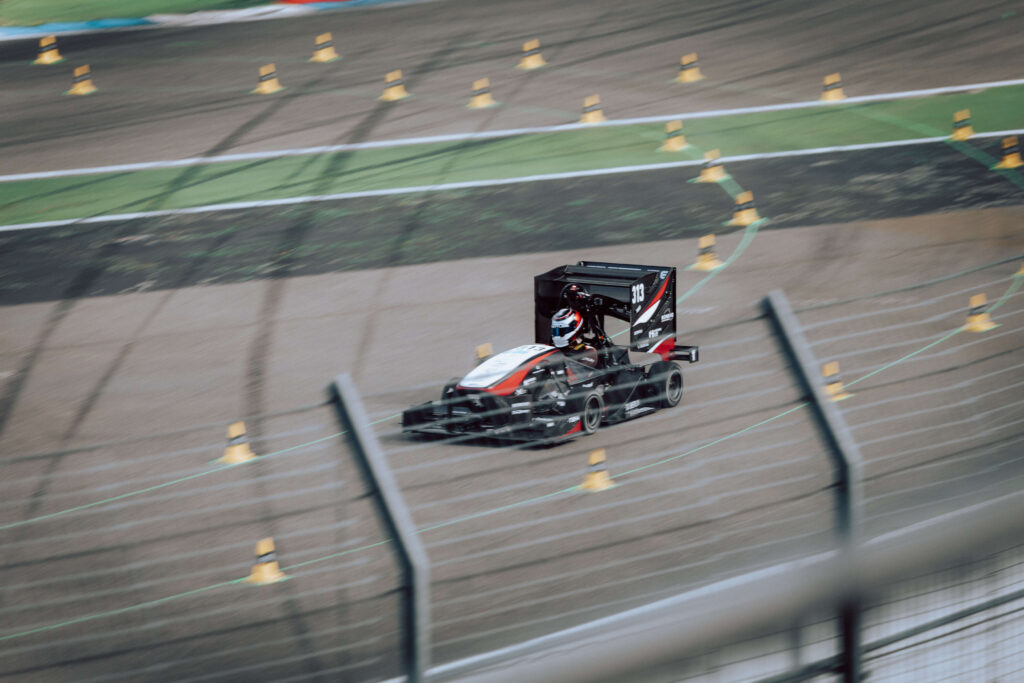
In this event, cars with drivers run a one-kilometre track, while driverless entries cover about half the distance. The course combines straights, bends, and tight chicanes. A strong lap reflects quick acceleration, precise steering, and effective braking. As in other events, striking cones leads to added time as a punishment. Results in this event determine starting order for endurance.
Maximum scores: 100 (with driver) and 100 (driverless).
As the most important challenge, endurance makes up the most points. Cars must demonstrate their durability over a 22-kilometre course. Speed, agility, energy usage, and reliability are all judged. Drivers will need to have a good control, as several cars share the circuit at once. Only one attempt is allowed, with a mandatory driver swap halfway.
Maximum scores: 250 (with driver).
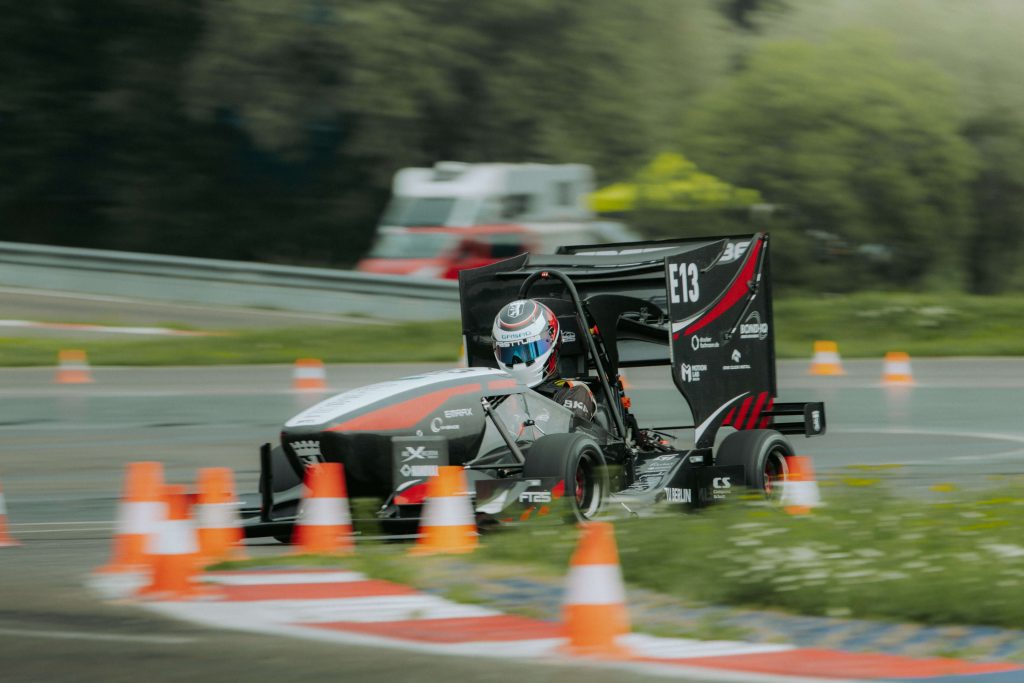
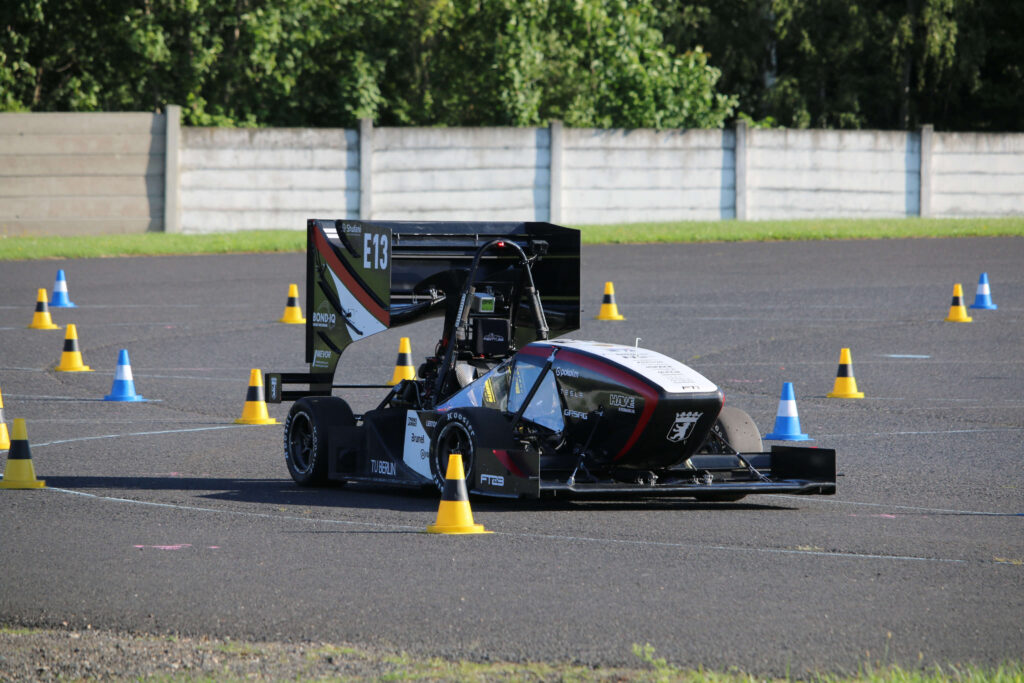
Alongside engineering design, track drive is the key event for driverless cars. Vehicles must cover ten laps without drivers involved, proving stability and reliability under long-term race conditions. The full distance must be done in a single attempt, and any cones knocked down will not be replaced.
Maximum scores: 200 (driverless).
During the endurance event, the energy consumption of each car is carefully measured. What counts is not the amount of fuel or electricity used, but rather the usage relative to speed. This prevents teams from driving overly slowly to gain advantage.
Maximum scores: 75.

Statische Events
Statische Events focus on the teams’ ability to handle real world hurdles of finances, business strategy and good engineering practice.
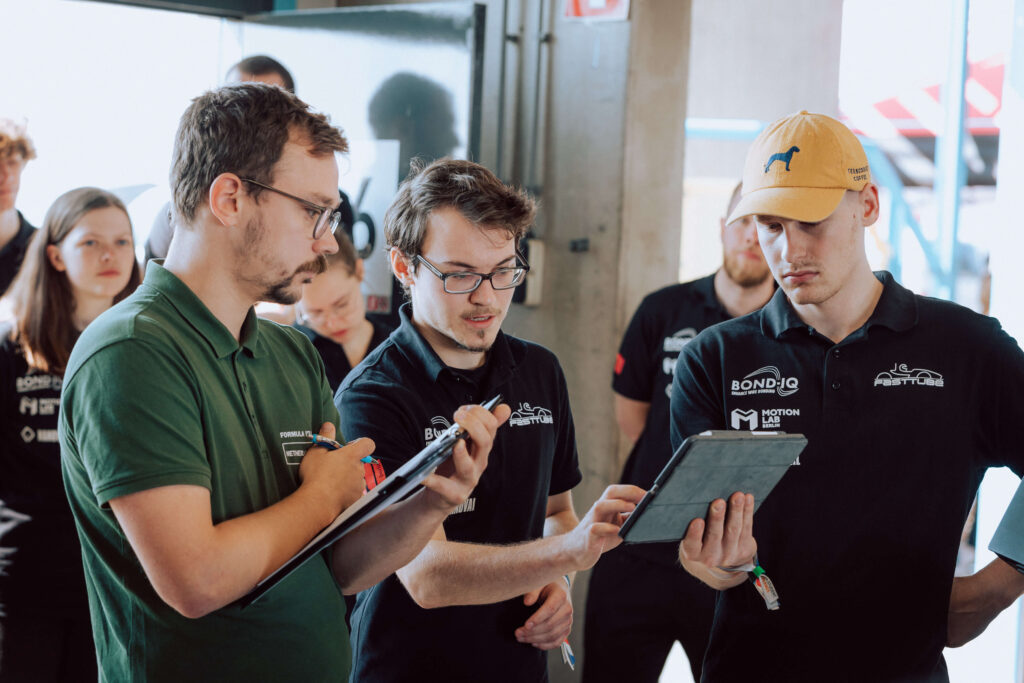
Für jede Veranstaltung reichen die Teams vorab eine detaillierte schriftliche Beschreibung ihres Fahrzeugs ein, in der sie ihr Design und dessen Umsetzung im Fahrzeug erläutern. Für selbstfahrende Autos ist zusätzlich ein Dokument mit einer Beschreibung des autonomen Systems erforderlich. Anhand dieser Einsendungen bewertet die Jury das technische Layout, den Designansatz und die Effektivität der Umsetzung des Konzepts im finalen Fahrzeug. Anschließend treffen sich die Teams persönlich mit der Jury, um Fragen zu beantworten, ihre Entscheidungen zu begründen und ihr Verständnis unter Beweis zu stellen. Die Bewertung berücksichtigt nicht nur die technische Lösung selbst, sondern auch die dahinter stehenden Gründe.
Da die Kosten bei der Produktentwicklung eine zentrale Rolle spielen, sind die Teams bei diesem Wettbewerb gefordert, ihren Prototypen vollständig aufzuschlüsseln. Sie müssen einen Kostenbericht einreichen, der Teile, Materialien und die Produktionsschritte umfasst. Im Anschluss an den Bericht findet eine Diskussion mit der Jury statt, in der die Teams ihre Berechnungen erläutern und ihr Verständnis der praktischen Aspekte des Fahrzeugbaus unter Beweis stellen. Dabei werden sowohl die Verständlichkeit des Berichts als auch das Verständnis der Studierenden für die Produktionsprozesse berücksichtigt.
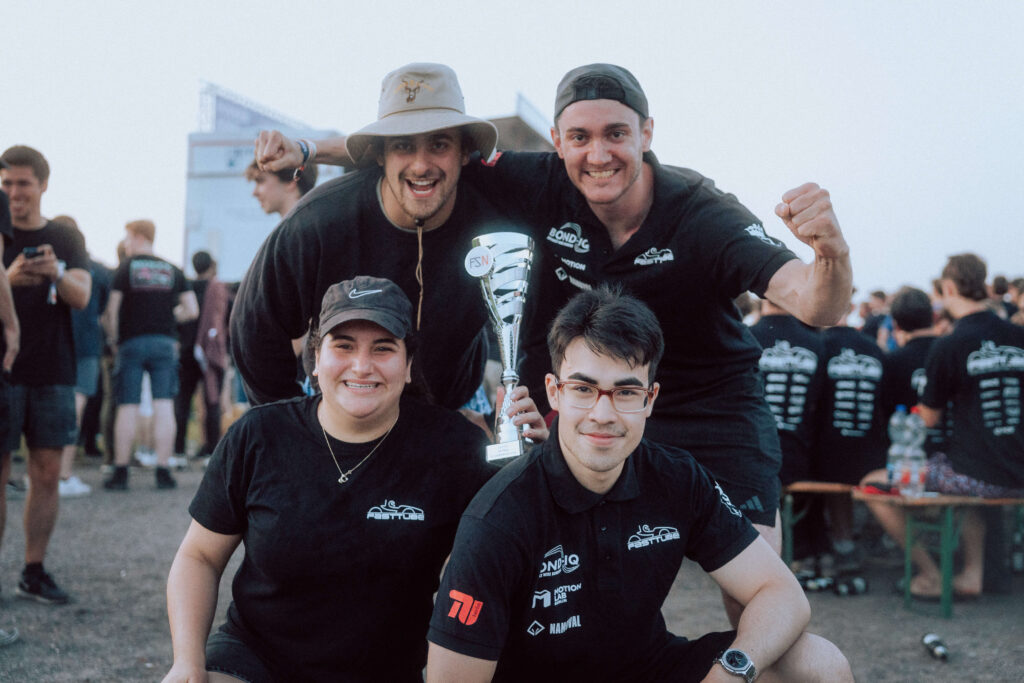
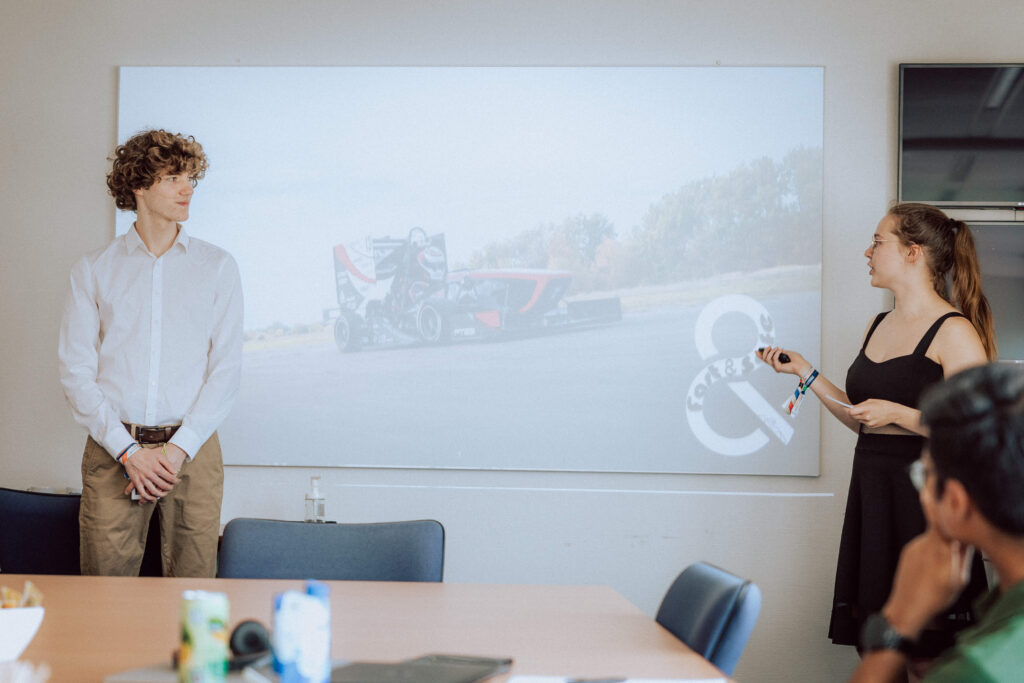
Jedes Team präsentiert ein Produkt oder eine Dienstleistung, die direkt mit dem Fahrzeug zusammenhängt, das es in der jeweiligen Saison entwickelt hat, so, als würde es es potenziellen Investoren präsentieren. Ziel ist es, die Jury – die als fiktives Unternehmen agiert – davon zu überzeugen, dass ihr Konzept die Bedürfnisse eines Zielmarktes erfüllt und kommerziell erfolgreich sein könnte. Im Anschluss an den Pitch folgt eine Fragerunde, in der das Team souverän und anpassungsfähig antworten muss. Bewertet werden sowohl Inhalt und Struktur der Präsentation als auch die Leistung des Teams bei der Durchführung.
